



“Everyone in this world is one of three kinds,” declares Mamaw (played by Glenn Close), the wise grand-matriarch of Ron Howard’s new film, Hillbilly Elegy. “A good Terminator, a bad Terminator, and neutral.” I hate to correct Mamaw, who is trying to encourage her impressionable grandson, J. D. Vance (Gabriel Basso), to follow a righteous path by invoking Arnold Schwarzenegger’s beloved action franchise. But there is no such thing as a “neutral” Terminator; those cyborg heroes exist to either protect or destroy. I cannot imagine what a neutral Terminator would do, save sit in a chair and remain forever shiny and inactive.
The Hillbilly Elegy Cast
Mamaw is entitled to her bad movie opinions, of course. But this monologue is the kind of speechifying that rings hollow throughout Hillbilly Elegy, an adaptation of Vance’s best-selling 2016 memoir that debuts on Netflix tomorrow. When it first arrived on bookshelves, Vance’s story was celebrated as a glimpse into an oft-ignored pocket of America: the white working class of Appalachia and the Rust Belt who swung to Donald Trump in the 2016 election. Hailed as an “anger translator” and cited by Oprah Winfrey and Hillary Clinton, Vance wrote about growing up poor, living with a heroin-addicted mother, and clawing his way into Yale Law School. The book arrived at a seemingly serendipitous moment, offering a bleak but candid view of communities gutted by drug abuse and poverty.
Recommended Reading
The Hillbilly Elegy True Story
The Hillbilly Elegy true story reveals that by the time J.D. Was born, Middletown's steel mill was no longer thriving and the town was gradually heading toward economic despair. Vance is portrayed by actor Owen Asztalos (left) in the movie. Vance as a child is pictured on the right. Hillbilly Elegy Read summaries of J.D. Vance's Hillbilly Elegy. You can read a full Book Overview as well as Chapter-by-Chapter Summaries. To purchase a copy of Hillbilly Elegy on BN.com, go to the link below. Hillbilly Elegy, the memoir, really took off in 2016, and became a looking glass for people attempting to understand working class white America.Vance's memoir avails itself as the perfect guide. Hillbilly Elegy 2020 R 1h 57m Dramas An urgent phone call pulls a Yale Law student back to his Ohio hometown, where he reflects on three generations of family history and his own future. Hillbilly Elegy is a passionate and personal analysis of a culture in crisis—that of white working-class Americans. The disintegration of this group, a process that has been slowly occurring now for more than forty years, has been reported with growing frequency and alarm, but has never before been written about as searingly from the inside.
Trump Excuses the White Working Class From the Politics of Personal Responsibility
Peter BeinartThe Original Underclass
Alec MacGillis and ProPublica
Recommended Reading
Trump Excuses the White Working Class From the Politics of Personal Responsibility
Peter BeinartThe Original Underclass
Alec MacGillis and ProPublica
Hillbilly Elegy the memoir has since been dissected, challenged, and eviscerated. It largely focuses on the virtues of hard work and perseverance, launching vague broadsides against the American welfare state; the author often appears uninterested in interrogating deeper systemic issues. In adapting the book, Howard and the screenwriter Vanessa Taylor have gone even further, stripping the text of anything that might feel remotely controversial or pointed. Netflix’s Hillbilly Elegy is an Oscar-friendly narrative of personal triumph in the face of great hardship, a movie designed to end with an uplifting epigraph; it is also one of the worst movies of the year. Stuffed with A-list stars and tearful monologues, it is a neutral Terminator of a film—polished yet utterly inert.
Howard, a filmmaker whose work I often enjoy, has a practiced hand with true-story movies (he directed Apollo 13, A Beautiful Mind, Cinderella Man, and Rush, among many others). But those stories usually have an incredible hook at their center, whether it’s the space chaos of Apollo 13 or the bitter suffering that the Formula 1 driver Niki Lauda experienced while pursuing victory in Rush (the latter might be Howard’s most underrated accomplishment of the past two decades). But in writing Hillbilly Elegy, Vance was pitching his tale not as extraordinary, but as merely one of thousands—his journey is inspiring, but it’s part of a larger social fabric, made compelling by the author’s pronouncements of how an entire generation of Americans had been left behind.
Perhaps that ambit is too much for a two-hour movie, or maybe Howard and Taylor were less intrigued by Vance’s sociopolitical analysis. Instead, the film plucks out the cleanest Hollywood narrative, one more clear-cut than even most Terminator movies. J. D. lives with his mother, Beverly (Amy Adams), in the Ohio steel town of Middletown (though the family hails from Eastern Kentucky), and while she’s sometimes sweet and loving, she’s often violent and neglectful, struggling with addiction issues and the pressures of single motherhood. With determination and the help of his wily grandma, J. D. eventually graduates from law school and makes something of himself.
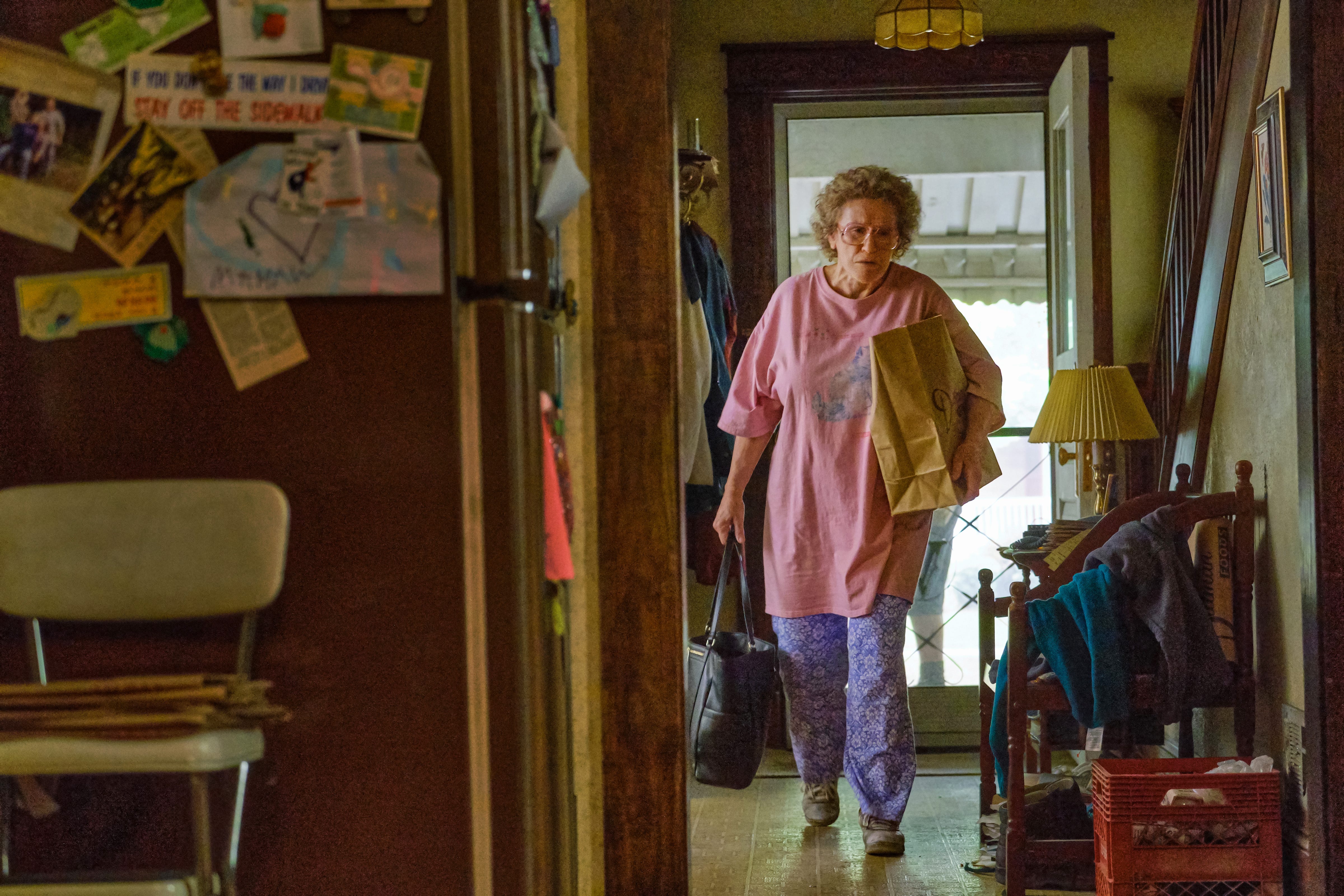
The film isn’t working with bigger ideas, so it overcompensates for its straightforward storyline by ladling on the histrionics, such as Mamaw’s pop-culture rants and Bev’s harrowing behavior (at one point, she threatens to drive her truck into oncoming traffic with J. D. in the car). Close’s performance in the film tends toward steely goofiness—dressed in a fright wig and baggy sweatshirts, she bustles around every scene cursing and yelling tough-love homilies at the camera lens. Adams’s work is unfortunately calibrated, a gross pantomime of suffering that sees her screaming dialogue to the heavens, as if pain can be understood by viewers only if it’s expressed at the highest volume.
Because J. D. is a calmer personality, the film exaggerates everything else around him. Hillbilly Elegy shows him being treated like a space alien once he enters the elite world of Yale. In one particularly mind-boggling scene, the revelation that he’s from a poor background causes stunned silence at a fancy dinner, suggesting these law academics have never met a working-class person before in their life. Anxious to prove his intellectual bona fides and ashamed of making some gross faux pas, J. D. dashes off to call his girlfriend, Usha (Freida Pinto), and consult her on which cutlery to use for which course.
As Alissa Wilkinson of Vox points out, none of this culture-clash material is so pronounced in Vance’s book. The author notes that his background was more of a curiosity to his friends at Yale, helping him stand out; it wasn’t something he shamefully hid from sight. But the adaptation cannot imagine this kind of nuance. I’m not surprised that the Hollywoodization of Hillbilly Elegy required imagined scenes of polarization to create narrative drama. The problem is that some audiences will look at such sequences and conclude that this film is offering insights into certain spheres of society. But Hillbilly Elegy is a think-piece trap; it might be tempting to view little moments as sweeping commentary, but the film’s ambitions simply aren’t that serious.
This movie could’ve succeeded as a story about human beings, not cartoons. Hillbilly Elegy is, after all, about real people who are still alive; they are named in the end credits and shown in photographs, as if to underline how carefully Close, Adams, and Basso were styled in their likeness. The props department indeed deserves praise for finding the right giant glasses to perch on Mamaw’s nose, and the perfect tangled nest for Bev’s hair. But Howard’s film is nothing more than a sensational snapshot, one that feels even less authentic than many of the think pieces that followed the release of Vance’s book in 2016. To Hollywood, J. D. is just another cookie-cutter hero, one who’s defeated the haziest of villains—adversity itself.
 © YouTube The real stories of the region stay buried in the foothills of the mountains, in favor of yarns that scratch a stereotype.
My mom has a copper plated stemless wine glass she always pulls out when I'm home. I tell her we can just use drinking glasses, but she insists. Catching up on work and recounting how long it had been since my last visit (too long), she asked me, a bit bluntly thanks to the Moscato,'Are you ever embarrassed of us back in New York?' It broke my heart, because even though I got what she was getting at, the answer has always been a firm no. Our house is humble. Neither of my parents are college educated, and the freezer on our back porch is filled with meat you can't buy at Kroger. It's not a world a lot of people get, and that makes it so easy to turn into a cartoon. I knew that she asked me that because to a big chunk of America, my lot of people are seen as dumb or backward. Embarrassing. That sentiment doesn't just appear out of nowhere.
It's why I felt unsettled when the long-awaited trailer for Netflix's Hillbilly Elegy dropped online months ago, long before it became an Oscar-nominated film that might land Glenn Close her long-awaited Academy Award. The film, adapted from J.D. Vance's New York Times best-selling memoir, is directed by Ron Howard and written by Vanessa Taylor (The Shape of Water, Game of Thrones). It stars Close and Amy Adams. At first glance, it appears to be real mad lib of an Oscar-bait film (despite getting overlooked for most nominations). Set in the town of Middletown, Ohio, the Appalachian narrative feels, at first, like a unique one worth celebrating. But after watching the trailer, having already read the book, it's obvious that, much like the source material itself, this could end up another portrait of an outsider's Appalachia: a marketable caricature of a proud community of people. An embarrassment worth paying attention to.
The story follows Vance's upbringing—which is without doubt a compelling story of a young man born into poverty and drug abuse who eventually enlists in the Marines, attends the Ohio State University, then later, Yale Law School. The story focuses primarily on the matriarchs of his family, his mother is played by Adams and his mamaw, Close. In the first couple seconds of the trailer, Adams can be seen slipping a pill into her mouth on route to a funeral. Later, Close shields a young Vance from seeing his mother picked up off the street. There are arrests and physical altercations and images of poverty abound. It's a who's who of the poor, white South. I have no qualms with Vance telling his story. To be honest, it's a gripping story, but one that exists within the vacuum of Vance's world. It's a vantage point into Appalachia, but not the only one. The larger issue with Hillbilly Elegy (both the film and the memoir) has to do with the stories that don't get told.

Hillbilly Elegy, the memoir, really took off in 2016, and became a looking glass for people attempting to understand working class white America. Vance's memoir avails itself as the perfect guide. His story encapsulates all the tropes of Appalachia: family, poverty, struggle. But what Vance really hones in on in the book is the idea that'his story' is'our story.' He uses his own circumstance to speak to a larger group, analyzing the details of his past as some sort of explanation as to why Appalachia as a whole is the way that outsiders see it. But the pill-addled mother and the wickedly protective (if not wickedly crude) mamaw are only a shade of the truth. More than anything, what resonates through the memoir and in the first trailer for the film is that this is a narrative about what it takes to escape. Mamaw, in one scene, literally says,'I know I could have done better. You got to decide if you want to be somebody or not.' Ultimately, Hillbilly Elegy isn't a portrait of Appalachia. It's Vance's exit strategy from a place that just can't cultivate a success story.
And there's the rub. I get the sentiment. I had two mamaws who could drink you through a case of Natural Light right quick. Growing up in East Tennessee, I lived in a trailer. I had cousins who got pregnant in high school and incarcerated a few years later. I, also, left Appalachia. I now write for a magazine in New York. But my story wasn't an escape. And if I left you with those details alone, based on what pop culture has told you about where I come from, then you could imagine exactly what my adolescence looked like. And that's because largely, that's all anyone outside of Appalachia has ever really been exposed to. We use those details because depictions are hard and being lazy is easy. Hillbilly Elegy has presented itself as a holistic view of Appalachia, using inclusive language that speaks too broadly for the whole. In its wake, it created an image too vivid and specific to be reversed without backpedaling and a fresh perspective. Vance's escape from Middletown has become the Cliff's Notes for an entire culture. And because it is well written, it serves as a light at the top of a ridge. We're just missing everything that lies in its shadows.
I know two things about my own story that seem to get lost in the phenom that is Hillbilly Elegy; I know that my story is only my own, and I know that staying in Appalachia is not a punishment. There's something irksome about stepping in to say,'This is my story. Let me represent this multi-state region of the world with it.' And for Appalachia in particular, it's damning for the predominant narrative to be one that reinforces so many stereotypes. Poverty and drug abuse are the outsiders' song of choice, and it helps further solidify that these are people who just don't know any better. Why would they ever want this without the sting of addiction and oppression keeping them down?
© Amazon From the looks of the first trailer, the film adaptation of Hillbilly Elegy hasn’t rid itself of the memoir’s original sin.And yet, there are so many people back in my neck of the woods who chose to stick around, calling Appalachia home for the rest of their lives. They became biologists who spend weeks at a time in the mountains, communing with nature and offering scientific insight into how climate change is affecting wildlife. One woman I know moved into a house on the same street as her parents, raising two kids and leading the community church's youth group with her husband. Those stories don't fit into the caricature well. Those stories stay buried in the foothills of the Appalachians in favor of yarns that scratch a stereotype. It's much more interesting to look at the grand product of an area than it is to ask why and how.

Knowing that there was only so much that could be done with the source material, I had hoped that the producers of the film would have at least cared to cart someone in from Appalachia to put the film together. Instead, the film is helmed by Howard, a born and raised Californian, and scripted by Taylor, a Coloradan-born, Michigan-educated writer. The desperation to check all the Oscar boxes seemed to take priority over leveraging the knowledge of someone familiar with the area, and what we're left with is Glenn Close, wide-eyed and draped in a stone-washed tee shirt with a faded cardinal on it. To the rest of the world, it might appear as a visceral portrait of poverty, but to those who know the real Appalachia, it reads as an invitation to gawk and pity at something that only vaguely represents home. And much like the writer of the memoir, those people get to leave it behind, talking about how effective it was, not knowing that the window they were looking through was incredibly narrow in scope.
When it comes to stories of Appalachia, I'm still waiting for more tales that depict the pride of living in such a lush and mysterious area. I long for stories that revere the resilience to stay as much as those that highlight the courage to leave. And when we have a breadth of those stories, penned and directed by people who live there, maybe the occasional story focused on the region's most dramatic qualities won't feel so pointed.
For four years, Hillbilly Elegy has resonated with audiences as an analytical look into part of America, but in the end, Vance's story fails to be the all-encompassing explanation of a 13-state region. No one person's story can. Neither his, nor mine. The issue isn't the story; it's the assumption that one story could say any more than the next. And from the looks of the trailer, I can only assume the film will continue Hillbilly Elegy's legacy, painting the portrait of what people like to believe Appalachia and its inhabitants are. Looking into my mom's eyes across the counter that day p***** me off. Because while asking if I ever thought they were an embarrassment, she seemed small. And she's not f****** small. And she surely isn't embarrassing. To quote the random character in the trailer working in what seems to be a Shoe Show,'Don't make us your excuse, JD.'
© Esquire Get Unlimited Access to Stories Like This One$40.00